

What Is the Feast of Tabernacles and Why Do Jews Live in Booths?

For one week each fall, many Jewish families move part of daily life outdoors. Meals are carried into a temporary hut. Children decorate the walls with paper chains, fruit, drawings, and lights. Guests sit under a roof made of branches, leaves, or bamboo. The structure is simple on purpose.
This holiday is called Sukkot, often translated as the Feast of Tabernacles or the Feast of Booths. It is one of the most joyful holidays on the Jewish calendar, but its meaning runs deep. It remembers a time when the Israelites lived in fragile shelters in the wilderness after the Exodus from Egypt. It also celebrates the harvest and teaches a spiritual lesson about trust, gratitude, and the limits of human security.
It's also an act of humility.
"God resists the proud but gives grace to the humble." James 4:6 NKJV.
It's a quote from Proverbs 3:34-35 (NKJV). "Surely He scorns the scornful, but gives grace to the humble. The wise shall inherit glory, but shame shall be the legacy of fools."
When the Lord Jesus establishes His kingdom on earth in Jerusalem during His millenial reign (see Revelation 20:1-6), the nations are commanded to show up in Jerusalem during the Feast of Tabernacles each year.
Zechariah 14:16-19 (NKJV) "And it shall come to pass that everyone who is left of all the nations which came against Jerusalem shall go up from year to year to worship the King, the LORD of hosts, and to keep the Feast of Tabernacles.
And it shall be that whichever of the families of the earth do not come up to Jerusalem to worship the King, the LORD of hosts, on them there will be no rain.
If the family of Egypt will not come up and enter in, they shall have no rain; they shall receive the plague with which the LORD strikes the nations who do not come up to keep the Feast of Tabernacles.
This shall be the punishment of Egypt and the punishment of all the nations that do not come up to keep the Feast of Tabernacles."

Sukkot is a biblical festival of booths and harvest
Sukkot begins on the 15th day of the Hebrew month of Tishrei, usually falling in September or October. It comes just a few days after Yom Kippur, the Day of Atonement. That timing matters. After the solemn work of repentance and forgiveness, the Jewish calendar turns toward joy, hospitality, and gratitude.
In the Torah, Sukkot is one of the three pilgrimage festivals, along with Passover and Shavuot. In ancient times, Israelites would travel to the Temple in Jerusalem for these festivals. Sukkot had a strong agricultural character because it came at the end of the harvest season. It marked the gathering in of produce before the rainy season.
That is why Sukkot has two connected identities:
It is a harvest festival, thanking God for the food and gifts of the land.
It is a historical festival, remembering the Israelites’ journey through the wilderness.
The English phrase “Feast of Tabernacles” can sound formal or distant, but the Hebrew word `sukkot` simply means “booths” or “temporary shelters.” One booth is called a `sukkah`. The name of the holiday comes from the central practice of the week, living in these booths.
What are the booths that Jews build?
The booth built for Sukkot is called a sukkah. It is not meant to be a permanent cabin or a polished outdoor room. It is a temporary dwelling, sturdy enough to use but fragile enough to remind people that life itself is not fully under human control.
A sukkah usually has walls made from wood, canvas, fabric panels, or other materials. Its most important feature is the roof, called `s’chach`. This roof must be made from natural material that grew from the ground and has been cut off from its source. Common choices include bamboo poles, palm branches, reeds, corn stalks, evergreen branches, or wooden slats.
The roof should provide shade, but it should not feel like a solid ceiling. In many sukkahs, sunlight filters through during the day, and stars may be visible at night. That mix is part of the experience. The sukkah offers shelter, but not complete control. It is a house with limits.
Inside, people often decorate the sukkah with:
Hanging fruit or harvest-themed decorations
Children’s artwork
Paper chains and garlands
Verses, blessings, or holiday signs
Lights for evening meals
A table and chairs for guests
In many homes, building the sukkah is a family project. Some begin shortly after Yom Kippur. The quick shift from fasting and prayer to hammering, tying, decorating, and preparing meals gives the season a special rhythm.
How long do Jews stay in the booths?
The Torah commands Jews to dwell in booths for seven days during Sukkot. This is the simple answer: Sukkot lasts seven days, and the sukkah is used throughout that week.
What “dwell” means can vary by community, climate, health, and family custom. At a minimum, many observant Jews eat meals in the sukkah during the holiday. Some also study, sing, talk, rest, welcome guests, and spend free time there. In communities where it is practical and safe, some people sleep in the sukkah as well.
The main idea is to treat the sukkah as a home for the holiday. Regular life moves into it as much as possible.
That does not mean people abandon their houses completely. Kitchens, bathrooms, bedrooms, and ordinary needs still exist. Rain, cold weather, illness, safety concerns, and other real-life limits can affect how much time someone spends in the sukkah. Jewish law recognizes that the sukkah should be a place of dwelling, not suffering.
A typical pattern might look like this:
Day or time | Common practice |
First night | Festive meal in the sukkah, with blessings |
First day | Holiday meals, prayer, rest, and time with family |
Middle days | Meals in the sukkah, work may be permitted depending on custom and religious observance |
Seventh day | A special day called Hoshana Rabbah, often marked with extra prayers |
After Sukkot | The holiday of Shemini Atzeret follows, though it is distinct from Sukkot |
In Israel, the day after the seven days of Sukkot is Shemini Atzeret, which is also when Simchat Torah is celebrated. Outside Israel, many Jewish communities observe Shemini Atzeret and Simchat Torah over two days. These days are connected on the calendar, but they are not part of the seven-day command to dwell in the sukkah in the same way.

Why do Jews live in booths during Sukkot?
The Torah gives a clear reason for the sukkah. Jewish people are told to live in booths so future generations will know that the Israelites lived in booths after God brought them out of Egypt.
That memory is not only about architecture. It is about dependence, vulnerability, and faith.
After the Exodus, the Israelites did not move directly into settled cities with stone houses and planted fields. They crossed the wilderness. They lived between slavery and homeland, between danger and promise. The sukkah recreates that in a physical way. Instead of only reading about the wilderness, people feel a small taste of temporary living.
The sukkah asks a quiet but powerful question: What do people really rely on?
Most of the year, a house can create the feeling of control. Walls, locks, roofs, insurance, schedules, savings, and routines all matter. They are good things. Sukkot does not reject them. But the holiday reminds people that none of them is absolute.
For one week, a person eats under branches. A breeze moves the walls. Rain may interrupt dinner. The table may wobble. Leaves may fall into the soup. The point is not discomfort for its own sake. The point is awareness.
The sukkah says that safety is not only built with stronger walls. It is also received as a gift.
The sukkah is both fragile and joyful
Sukkot is sometimes called `z’man simchateinu`, “the season of our joy.” That might seem surprising. Why would joy be connected to a hut that can be shaken by wind?
That is one of the holiday’s deepest lessons. Joy does not require perfect conditions. It can grow in a temporary place, around a shared table, under a roof that lets in moonlight.
Sukkot joy is practical and embodied. People eat. They sing. They invite guests. They make blessings over bread and wine. They bring children into the building and decorating. They add beauty to a structure that will soon be taken down.
That temporary beauty is part of the meaning. The sukkah lasts only a week, yet people still decorate it. They still make it welcoming. They still treat it as special.
This reflects a larger spiritual truth found throughout Jewish life: temporary things can carry lasting holiness. A meal can become sacred. A hut can become a home. A week can shape memory for a lifetime.
The four species add another layer of meaning
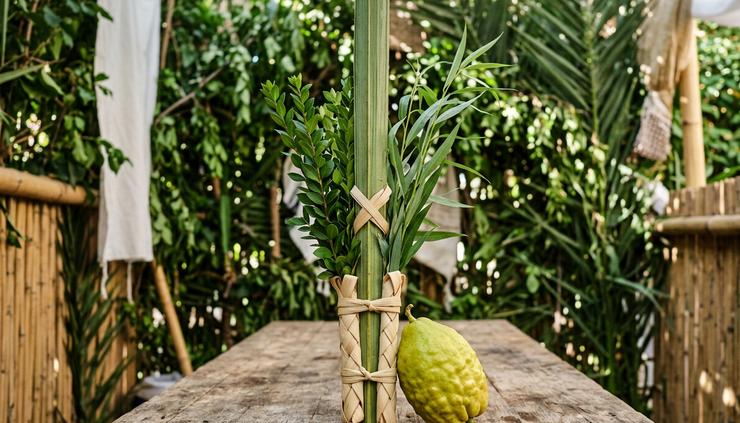
Along with dwelling in a sukkah, Sukkot includes another well-known ritual: taking the four species. These are:
`Etrog`
A citron fruit with a bright color and strong fragrance
`Lulav`
A palm branch
`Hadassim`
Myrtle branches
`Aravot`
Willow branches
These are held together and waved in different directions during the holiday, except on Shabbat in many traditions. The four species are often understood as symbols of harvest, unity, and praise. They bring the natural world directly into worship.
The sukkah and the four species belong together. Both use physical objects from the earth. Both connect the holiday to agriculture. Both invite people to serve God with the body, not only with thoughts or words.
Sukkot is not an abstract holiday. It is felt in the hands, seen in the branches, tasted in the meals, and heard in the songs around the table.
The sukkah welcomes guests
Hospitality is a major theme of Sukkot. Many families invite relatives, friends, neighbors, students, travelers, or community members to share meals in the sukkah. The small space encourages closeness. People sit shoulder to shoulder. Conversation becomes part of the holiday.
There is also a mystical custom called `ushpizin`, an Aramaic word meaning “guests.” In this tradition, symbolic biblical guests are welcomed into the sukkah each night. Different communities name them in different ways, but the practice adds a sense that the sukkah is shared across generations.
The guest theme fits the structure itself. A sukkah is open. It is not sealed off like a fortress. It reminds those inside that they, too, have been travelers. They, too, depend on welcome.
This memory has ethical weight. Remembering fragile shelter can deepen compassion for people who lack stable housing, safety, or community. The holiday does not reduce that issue to a symbol, but it does make vulnerability harder to ignore.
What Sukkot means today
For Jewish communities today, Sukkot carries many meanings at once.
It is a link to the Exodus story. It is a harvest celebration. It is a family tradition. It is a commandment. It is a spiritual exercise in gratitude. It is also a yearly reset, a reminder that life’s most solid things may still be temporary.
In a modern setting, the sukkah can feel especially countercultural. Much of daily life pushes people indoors, onto screens, and toward personal comfort. Sukkot moves prayer, food, and conversation outside. It slows people down and places them under a roof that cannot pretend to be permanent.
That change can be refreshing. A person may notice the temperature of the evening air, the shape of the moon, the sound of leaves, or the pleasure of eating with others without the usual distractions. The sukkah makes room for attention.
It also balances humility with celebration. The holiday does not say, “You own nothing, so do not rejoice.” It says, “Because life is a gift, rejoice with gratitude.”
A simple way to understand the Feast of Tabernacles
The Feast of Tabernacles is a seven-day Jewish holiday when Jews dwell in temporary booths called sukkahs. These booths remember the shelters of the Israelites in the wilderness and celebrate the harvest season. Many Jews eat in the sukkah, spend time there, welcome guests, and in some communities sleep there.
The sukkah is temporary by design. Its weakness is its message. It teaches that security is never only about strong walls. It comes from God, community, memory, gratitude, and care for others.

By the end of the week, the sukkah comes down. The decorations are packed away. The table returns indoors. But the lesson is meant to remain: homes matter, harvests are gifts, joy can live in fragile places, and gratitude grows when people remember how much of life is received rather than owned.


Comments